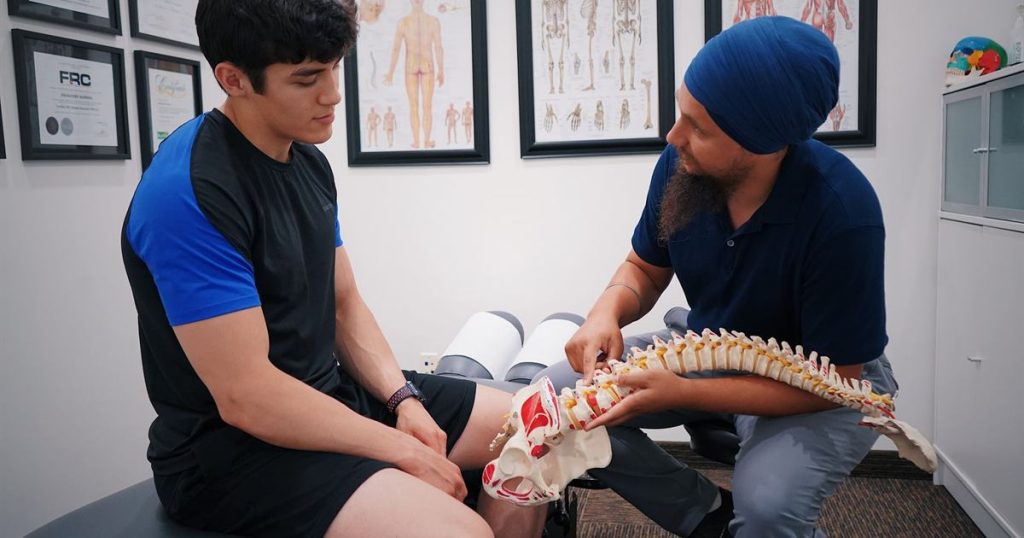
The honest answer involves naming the risks rather than dismissing the question.
Table of Contents
- Is Chiropractic Care Safe?
- Known Risks and How Rare They Are
- Normal Soreness Versus a Problem
- What Happens at a First Visit
- “Is It Just Pseudoscience?”
- Warning Signs of a Provider to Avoid
- FAQs About Whether Chiropractic Care Is Safe
Searching this question returns two kinds of page. Clinic sites saying it is completely safe, and forums saying it is dangerous.
Neither helps you decide. Every treatment carries some risk, and useful information tells you what those risks are, how likely they are, and what reduces them.
Is chiropractic care safe is a fair question that deserves a direct answer rather than reassurance. This guide covers the known risks, what a proper first visit involves, how to read the criticism, and the specific things that should make you leave a clinic.
Is Chiropractic Care Safe?
Chiropractic care is usually considered safe when delivered by a licensed provider after appropriate screening. The most common effect is temporary soreness after treatment, reported by a substantial minority of patients and typically resolving within 24 to 48 hours. Serious adverse events are rare in the published literature. Risk relates far more to screening quality and technique selection than to the treatment category itself.
That last sentence is the important one.
Safety is not a property of chiropractic in general. It is a property of a specific provider examining a specific person and choosing an appropriate technique.
Known Risks and How Rare They Are
Three categories of risk, in descending frequency.
Common and minor. Soreness in the treated area, temporary stiffness, mild headache, fatigue after treatment. These settle within a day or two and are the ordinary response to manual therapy.
Uncommon. Increased pain requiring a change of approach, rib irritation with forceful thoracic technique, and aggravation of an undiagnosed underlying condition.
Rare and serious. The most discussed is cervical artery dissection, a tear in an artery in the neck, which can cause stroke. This is the risk behind most criticism of neck manipulation.
The evidence on that association is genuinely debated. Some research suggests people with an artery already tearing seek treatment for the neck pain the tear causes, meaning the visit follows the problem rather than causing it. Other work argues for a causal contribution. It has not been fully settled.
What follows from that uncertainty is practical. Screening matters, lower-force alternatives exist, and any provider should discuss both. Risks of chiropractic care being rare is not a reason to skip the conversation.
Normal Soreness Versus a Problem
Knowing the difference prevents both unnecessary worry and dangerous delay.
Expected. Mild ache in the treated area starting within a few hours, similar to the day after unfamiliar exercise, settling within 24 to 48 hours, and improving with gentle movement.
Not expected. Pain that is sharp rather than achy, symptoms that are worse at 72 hours than at 24, new symptoms in a limb, or anything involving your head and vision.
Contact your provider the same day for any of the following.
- Severe headache unlike any you have had before
- Dizziness, visual changes, or difficulty speaking
- Numbness, weakness, or tingling in an arm or leg
- Facial numbness or loss of coordination
Can chiropractic care hurt you is best answered by that list. The likelihood is low. The correct response to those symptoms is immediate regardless.
What Happens at a First Visit
A proper first appointment is mostly conversation and examination. Treatment, where it happens at all, comes last.
Expect a detailed history covering your symptoms, previous injuries, medical conditions, medications, and any history of headaches, dizziness, or vascular problems. Those last three exist in particular to screen for the rare risks.
Physical examination covers range of motion, joint restriction, muscle testing, and a neurological screen of reflexes, strength, and sensation.
You should leave with an explanation of what your provider found, what they think is causing it, what treatment they propose, and roughly how long before you reassess.
What to expect from chiropractic care on day one is not a long treatment. A provider who adjusts you within five minutes of meeting you has not examined you.
“Is It Just Pseudoscience?”
The criticism is worth engaging with rather than dodging, since it contains something true.
Chiropractic began in the 1890s with a theory that spinal misalignment caused most disease. That original theory is not supported by evidence and has been abandoned by most of the profession.
The part that holds up is manual therapy for musculoskeletal problems. Spinal manipulation for low back pain appears in clinical guidelines from bodies including the
American College of Physicians, alongside other conservative treatments.
The part that does not hold up is any claim that adjustment treats conditions unrelated to the musculoskeletal system. Immune function, blood pressure, allergies, and general wellness through adjustment are not supported.
A clinic describing itself as evidence based should be willing to say that plainly. Judging a provider by which claims they make is more useful than judging the whole field.
Warning Signs of a Provider to Avoid
Six things should end the relationship.
- Treatment on the first visit with no meaningful examination
- A large pre-paid package required before any assessment
- Routine X-rays for everyone regardless of symptoms
- Claims to treat conditions unrelated to the musculoskeletal system
- Discouraging you from seeing your physician, or from telling them
- A plan that never reduces in frequency no matter how well you do
The last one is the most common and the least dramatic. Care that improves you should require less of you over time.
Good practice looks like the opposite. Examination before treatment, clear reassessment points, referral where indicated, and a plan that tapers.
FAQs About Whether Chiropractic Care Is Safe
Is chiropractic care safe for everyone? No treatment suits everyone. Certain conditions require modified technique or rule out manipulation, including osteoporosis, inflammatory arthritis, recent fracture, spinal infection, some cancers, and bleeding disorders. This is why the history matters. Disclose all conditions and medications, and appropriate alternatives can be used.
Is neck adjustment more dangerous than back adjustment? The rare serious risk discussed in the literature relates in particular to the neck. The likelihood remains low, and lower-force alternatives including mobilization and instrument-assisted technique are available. Tell your provider if you would prefer to avoid manipulation of the neck and it will be accommodated.
Is chiropractic care safe during pregnancy? It is widely considered safe with a provider trained in prenatal technique, using pregnancy-appropriate positioning and reduced force. Certain complications require postponing treatment and referring to your obstetric team. Tell any provider you are pregnant before treatment, including very early on.
Is chiropractic care safe for children? Serious adverse events in children are rare when treatment is delivered by a provider with pediatric training using age-appropriate force. Adult technique is never appropriate for a child. Ask directly what pediatric training a provider holds.
What should I do if I feel worse after treatment? Mild soreness for a day or two is expected. Contact your provider the same day for pain that is sharp, worsening after 48 hours, or accompanied by new limb symptoms. Seek emergency care immediately for severe headache, dizziness, visual changes, or difficulty speaking.
Ask Your Questions Before You Book
A clinic that answers safety questions directly on the phone is showing you how it operates. Ask before you commit to anything.
Caron Chiropractic has provided
chiropractic care in St. Paul for over 30 years, rated 4.9 stars across 385 Google reviews.
Ask My Questions or call (651) 255-9999.
Reviewed by Matthew R. Caron, D.C., Northwestern College of Chiropractic, 1992.
This article is general information, not medical advice.