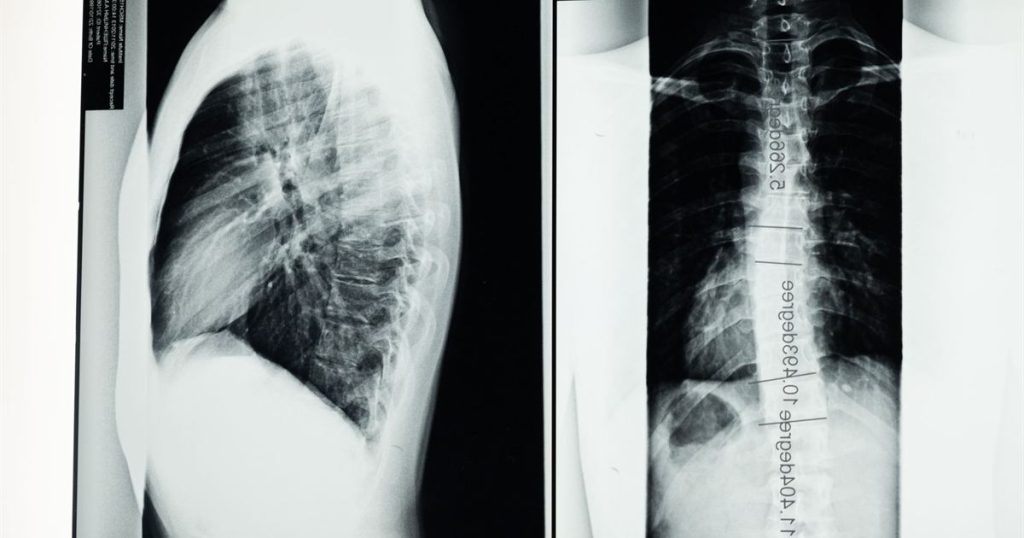
Treatment can help how your back feels. It does not straighten the curve, and any clinic saying otherwise is selling something.
Table of Contents
- What Scoliosis Actually Is
- What Chiropractic Care for Scoliosis Can Do
- What It Cannot Do
- Adolescent Scoliosis and Monitoring
- Adult Scoliosis and Degenerative Curves
- Bracing, Surgery, and When They Apply
- FAQs About Chiropractic Care for Scoliosis
Search this topic and you will find clinics advertising scoliosis correction, complete with before and after X-rays.
Be careful with those. Scoliosis is a structural condition, and the evidence for manual therapy reducing a curve is weak.
What treatment genuinely offers is pain management, better mobility, and support for the muscular problems that come with an asymmetrical spine. Chiropractic care for scoliosis is worth having on those terms. This guide sets out what to expect and what to be skeptical about.
What Scoliosis Actually Is
Scoliosis is a sideways curvature of the spine with a rotational component, measured on X-ray using the Cobb angle. A curve of 10 degrees or more meets the definition.
Categories matter for what happens next.
Idiopathic scoliosis has no identified cause and accounts for most cases, usually appearing during adolescent growth.
Degenerative scoliosis develops in adults as discs and joints wear asymmetrically.
Congenital and neuromuscular scoliosis relate to vertebral malformation or underlying neurological conditions.
Severity drives management. Mild curves are usually monitored, moderate curves in growing adolescents may be braced, and large curves may need surgical assessment.
The rotational element is why scoliosis is not simply a sideways bend. That rotation is what produces the rib prominence visible when someone bends forward.
What Chiropractic Care for Scoliosis Can Do
Treatment addresses the consequences of the curve rather than the curve itself.
Pain management. Asymmetrical loading produces muscular pain, joint irritation, and stiffness. These respond to treatment as they would in anyone.
Mobility. Segments above and below a curve often become restricted. Restoring their motion improves overall movement.
Muscular balance. Muscles on the concave side shorten when the convex side lengthens and works harder. Soft tissue work and targeted exercise address that imbalance.
Monitoring. Regular assessment tracks whether a curve is stable or progressing, particularly during adolescent growth.
Scoliosis treatment chiropractic care delivers is symptomatic and supportive. That is a legitimate and useful role, and describing it accurately is what separates a responsible clinic from a marketing operation.
What It Cannot Do
The evidence does not support spinal manipulation reducing a scoliotic curve.
Curves shown to reduce on repeat X-ray are frequently the product of positioning differences between images rather than structural change. Small differences in how someone stands, or in how the image was taken, change the measured Cobb angle.
Be cautious with clinics offering intensive scoliosis correction programs at high cost, before and after images as primary evidence, guarantees of curve reduction, or long pre-paid packages for children.
Specific exercise approaches such as Schroth-based methods have a developing evidence base, mainly around slowing progression and improving function rather than reversing established curves. That is different from manipulation-based correction claims.
The
Scoliosis Research Society publishes patient information setting out current management standards, and it is worth reading before committing to any program.
Adolescent Scoliosis and Monitoring
Adolescent idiopathic scoliosis usually appears during growth, and growth is when curves are most likely to progress.
Monitoring matters more than treatment at this stage. Progression risk relates to how much growing remains and how large the curve already is.
Signs parents notice include uneven shoulders, one shoulder blade more prominent, uneven waist, or a rib prominence when the child bends forward.
Management should be led by an orthopedic specialist for anything beyond a mild curve. Chiropractic care can run alongside for pain and mobility, and it does not replace specialist monitoring.
Routine repeat X-rays should be minimized in growing children. Imaging is done at intervals determined by a specialist, not at every visit.
Adult Scoliosis and Degenerative Curves
Adult scoliosis presents differently and is more often symptomatic.
Two groups exist. Adults with idiopathic curves carried from adolescence, and adults developing degenerative curves through asymmetrical wear.
Pain is the usual complaint rather than appearance. Back pain, leg symptoms from nerve compression where the curve narrows the spinal canal, and fatigue from asymmetrical muscle work.
Treatment aims at function. Scoliosis and chiropractic care in adults is about maintaining mobility, managing pain, and supporting the strength that helps you tolerate the curve.
Curves in adults do not need correcting to be manageable. Plenty of people live comfortably with substantial curves, and comfort rather than measurement is the goal.
Bracing, Surgery, and When They Apply
Both are specialist decisions and neither is a chiropractic call.
Bracing applies to growing adolescents with moderate curves, aiming to slow progression during remaining growth. It does not reduce an existing curve and it is not used in skeletally mature adults.
Surgery is usually considered for large curves, curves progressing even with bracing, or adult curves causing significant pain or neurological symptoms that have not responded to conservative care.
Referral is appropriate for any adolescent with a suspected curve, any curve appearing to progress, neurological symptoms alongside a curve, or significant pain not responding to conservative treatment.
A provider treating scoliosis without any relationship to specialist monitoring is working outside a reasonable model of care.
FAQs About Chiropractic Care for Scoliosis
Can chiropractic care straighten scoliosis? No. The evidence does not support spinal manipulation reducing a scoliotic curve. Treatment helps pain, mobility, and muscular imbalance around the curve. Claims of curve correction, particularly those relying on before and after X-rays, should be treated with caution since positioning differences alter measurements.
Is chiropractic safe with scoliosis? Usually yes, with technique adapted to the curve and to bone density. The provider should know your curve type and severity, and should have seen recent imaging or specialist correspondence. Adolescents should be under specialist monitoring alongside any treatment.
Will treatment stop my child’s curve from progressing? There is no good evidence that manipulation prevents progression. Progression risk relates to remaining growth and current curve size, and monitoring is led by an orthopedic specialist. Bracing is the established intervention for moderate curves during growth.
Does scoliosis always cause pain? No. Many people with mild curves have no symptoms and discover them incidentally. Pain is more common in adults, particularly with degenerative curves, and relates more to how the spine loads than to the size of the curve itself.
How often should scoliosis be X-rayed? Intervals are set by the specialist monitoring the curve, based on age, growth, and curve size. Routine imaging at every chiropractic visit is not appropriate, particularly in children where cumulative radiation exposure matters.
Get Your Symptoms Assessed
Treatment aimed at how your back feels and moves is worth having. Treatment sold as straightening your spine is not. An assessment sets realistic expectations first.
Caron Chiropractic has provided
chiropractic care in St. Paul for over 30 years, rated 4.9 stars across 385 Google reviews.
Book My Assessment or call (651) 255-9999.
Reviewed by Matthew R. Caron, D.C., Northwestern College of Chiropractic, 1992.
This article is general information, not medical advice.