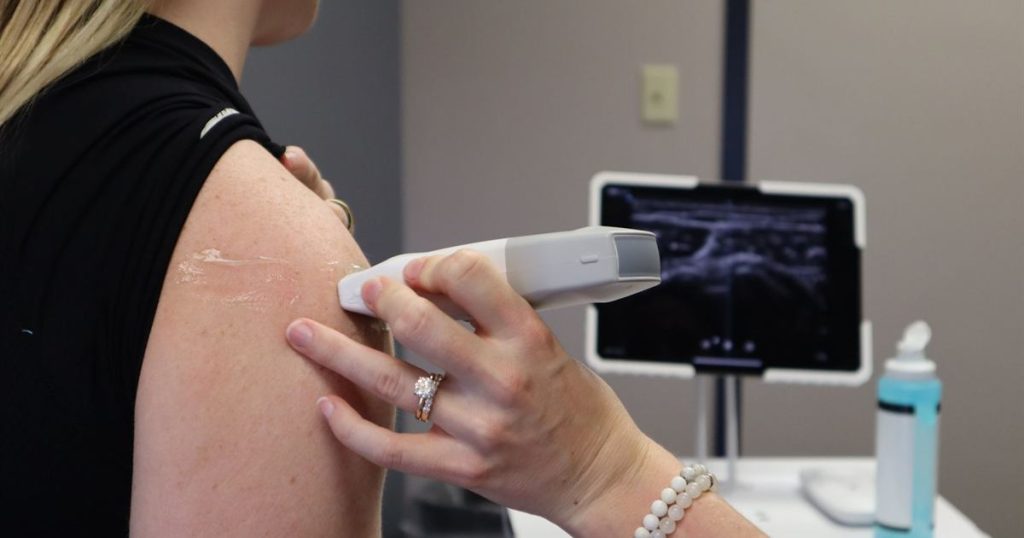
Chiropractic is assumed to be a spine-only service. Most limb pain has a spinal contribution, which is exactly why.
Table of Contents
- Why Joint Pain Often Starts Elsewhere
- Chiropractic Care for Shoulder Pain and Rotator Cuff
- Frozen Shoulder and What Actually Helps
- Bursitis in the Shoulder and Hip
- Knee Pain and Hip Mechanics
- When Surgery Is the Right Answer
- FAQs About Chiropractic Care for Shoulder Pain
Your shoulder hurts when you reach overhead. You have rested it, iced it, and stretched it for two months.
Nothing has changed, since the restriction causing it sits in your mid-back rather than your shoulder.
Chiropractic care for shoulder pain works on that relationship. The shoulder blade sits on the ribcage, the ribcage moves with the thoracic spine, and a stiff mid-back limits shoulder movement before the shoulder itself is involved. This guide covers how limb pain is assessed, what responds to treatment, and when the answer is a surgeon.
Why Joint Pain Often Starts Elsewhere
Joints work in chains. Restriction in one produces compensation in the next.
Three relationships explain most limb pain seen in a chiropractic clinic.
Thoracic spine and shoulder. Raising your arm overhead requires your mid-back to extend and your shoulder blade to rotate. A stiff thoracic spine forces the shoulder joint to make up the difference, which compresses the tendons running through it.
Hip and knee. A hip that rotates poorly changes the angle your knee tracks through. Repeat that through thousands of steps and the knee takes load it was not built for.
Foot and everything above. Ankle stiffness alters knee and hip loading directly.
This is why assessment covers more than the painful joint. Treating only where it hurts is the reason problems recur after they settle.
Chiropractic Care for Shoulder Pain and Rotator Cuff
The rotator cuff is four small muscles holding the ball of the shoulder centered in its socket when larger muscles move the arm.
Problems occur where those tendons get compressed in the space above them, called impingement, or where they are irritated by overload.
Rotator cuff chiropractic care targets three things. Thoracic mobility, so the shoulder blade can rotate properly. Shoulder blade control, since the cuff cannot work well on an unstable base. Soft tissue tension in the surrounding muscles.
Chiropractic care for neck and shoulder pain together is common, since the nerves supplying the shoulder originate in the neck. Pain travelling below the elbow, or with numbness, needs the neck examined regardless of where it hurts.
Full-thickness tears are a different situation. Those are assessed for surgical opinion rather than managed conservatively in most cases.
Frozen Shoulder and What Actually Helps
Frozen shoulder, or adhesive capsulitis, is its own condition and behaves unlike other shoulder problems.
The joint capsule thickens and tightens, progressively restricting movement. It runs through recognized stages, typically a painful freezing phase, a stiff frozen phase, and a gradual thawing phase, and the whole process commonly takes many months.
Frozen shoulder chiropractic care works with the stage rather than against it. Aggressive stretching during the painful freezing phase increases irritation and prolongs it. Gentle mobility work and pain management suit that stage. The thawing phase tolerates and benefits from more.
Expectations matter here more than anywhere. Treatment supports the process and manages pain. Nothing shortens frozen shoulder dramatically, and any provider promising rapid resolution is not describing this condition accurately.
It is more common in people with diabetes, which is worth knowing and worth mentioning at assessment.
Bursitis in the Shoulder and Hip
A bursa is a fluid-filled sac reducing friction where tendon passes over bone. Irritated bursae produce sharp, localized pain.
Chiropractic care for bursitis addresses what caused the friction rather than the bursa alone. Shoulder bursitis usually accompanies impingement, so thoracic mobility and shoulder blade control are the targets. Hip bursitis on the outside of the hip usually relates to glute weakness and hip mechanics.
Treating the bursa alone tends to help temporarily. The friction returns since the mechanics that produced it have not changed.
Load management matters alongside treatment. Continuing the activity that caused the irritation when treating it produces a stalemate.
Knee Pain and Hip Mechanics
Chiropractic care for knee pain focuses on how the knee is loaded rather than the knee itself, since the knee is a simple hinge caught between two mobile joints.
Common presentations and what they usually relate to:
- Pain around the kneecap often relates to hip control and how the thigh rotates
- IT band pain on the outside relates to hip mechanics and glute function
- Pain below the kneecap suggests patellar tendinopathy, a loading problem
- Deep aching with stiffness in older adults often relates to osteoarthritis
Knee osteoarthritis is worth naming honestly. Treatment does not reverse cartilage change. It can improve joint mobility, address the muscular compensation around it, and support the strengthening that reduces symptoms.
Hip pain is assessed alongside, since hip osteoarthritis frequently refers pain into the knee or groin and gets attributed to the wrong joint.
When Surgery Is the Right Answer
Conservative care suits most joint pain and not all of it.
Situations that usually need surgical assessment include full-thickness rotator cuff tears with significant weakness, mechanical locking or giving way in a knee, advanced osteoarthritis with substantial functional loss, and any joint problem following significant trauma.
Progressive weakness always warrants assessment rather than continued conservative treatment.
The
American Academy of Orthopaedic Surgeons publishes patient information on when surgical opinion is appropriate across these conditions.
A provider should tell you when they have reached the limit of what they can offer. Continued treatment past that point costs you time and money without changing the outcome.
FAQs About Chiropractic Care for Shoulder Pain
Can a chiropractor treat shoulder pain? Yes, where the cause is mechanical. Treatment usually addresses thoracic spine mobility, shoulder blade control, and surrounding soft tissue rather than the shoulder joint alone. Assessment establishes whether the shoulder, the neck, or the mid-back is the primary driver, and full-thickness tears are referred for surgical opinion.
How can chiropractic care help with knee pain? By addressing how the knee is loaded. Hip mechanics, ankle mobility, and muscular control all determine the forces travelling through the knee. Treatment targets those alongside the knee itself. Structural damage such as advanced arthritis is managed rather than reversed.
Is shoulder pain coming from my neck? Sometimes. Nerves supplying the shoulder originate in the neck, so neck problems refer pain into the shoulder and upper arm. Pain travelling below the elbow, or accompanied by numbness, tingling, or weakness, points toward the neck and needs it examined.
How long does frozen shoulder take to resolve? Frozen shoulder typically runs over many months through freezing, frozen, and thawing stages. Treatment manages pain and maintains what mobility is available, matched to the stage. No treatment dramatically shortens the overall course, and claims otherwise misrepresent the condition.
Should I use heat or ice on joint pain? Ice suits acute flare-ups with swelling in the first 48 hours. Heat suits ongoing stiffness and muscular tension. For long-standing joint pain without recent injury, heat before movement is usually more comfortable. Neither addresses the mechanics causing the problem.
Get Your Joint Pain Assessed Properly
Two months of treating the painful joint without change usually means the driver sits somewhere else. An assessment covers the chain rather than the spot.
Caron Chiropractic provides
chiropractic care in St. Paul, rated 4.9 stars across 385 Google reviews.
Book My Joint Assessment or call (651) 255-9999.
Reviewed by Corey McFarlane, D.C., Northwestern Health Sciences University, 2014.
This article is general information, not medical advice.