A treatment that works by deliberately irritating tissue sounds wrong. Here is why it is the point.
Table of Contents
- What Is Shock Wave Therapy?
- Radial and Focused Shock Wave Therapy
- What a Session Actually Involves
- What It Treats
- Does Shock Wave Therapy Work?
- Can It Cause Damage?
- FAQs About Shock Wave Therapy
Most soft tissue injuries heal in weeks. A small number stall, and the ones that stall behave differently from fresh injuries.
Tendon and fascia problems lasting six months are usually not inflamed any more. The tissue has degenerated and the healing process has stopped rather than continued badly.
Shock wave therapy exists for that situation. It applies acoustic pressure waves to restart a repair process that gave up. This guide covers how it works, the difference between the two types, what conditions it treats, and what the research supports.
What Is Shock Wave Therapy?
Shock wave therapy delivers high-energy acoustic pressure waves into injured tissue through a handheld applicator pressed against the skin. The waves create controlled mechanical stress that stimulates blood vessel formation, increases cellular repair activity, and reduces local pain signaling. It is non-surgical, requires no anesthetic, and is delivered in short outpatient sessions.
Extracorporeal shock wave therapy is the formal name, often shortened to ESWT. Extracorporeal simply means the energy is generated outside the body and transmitted in.
The technology started in medicine as lithotripsy, breaking up kidney stones. Musculoskeletal use developed from the observation that bone and soft tissue near treated areas showed increased healing activity.
Modern devices deliver far lower energy than lithotripsy units. The goal is stimulation, not destruction.
Radial and Focused Shock Wave Therapy
Two types exist and they are not interchangeable.
Radial shock wave therapy spreads energy outward from the applicator tip, dispersing as it travels. Energy concentrates near the surface, making it well suited to conditions within a few centimeters of the skin.
Focused shock wave therapy converges energy to a defined point at a set depth. It reaches deeper structures and delivers higher peak pressure to a smaller area.
Caron Chiropractic uses radial shockwave. Most common musculoskeletal targets, including the plantar fascia, Achilles tendon, and the tendons at the elbow, sit within radial range.
Low intensity shock wave therapy is a separate category again, used at much lower energy levels for different applications entirely. Acoustic shock wave therapy is usually used interchangeably with radial.
Ask which type a clinic uses. A provider who cannot answer clearly is worth a second thought.
What a Session Actually Involves
There is less to it than most people expect.
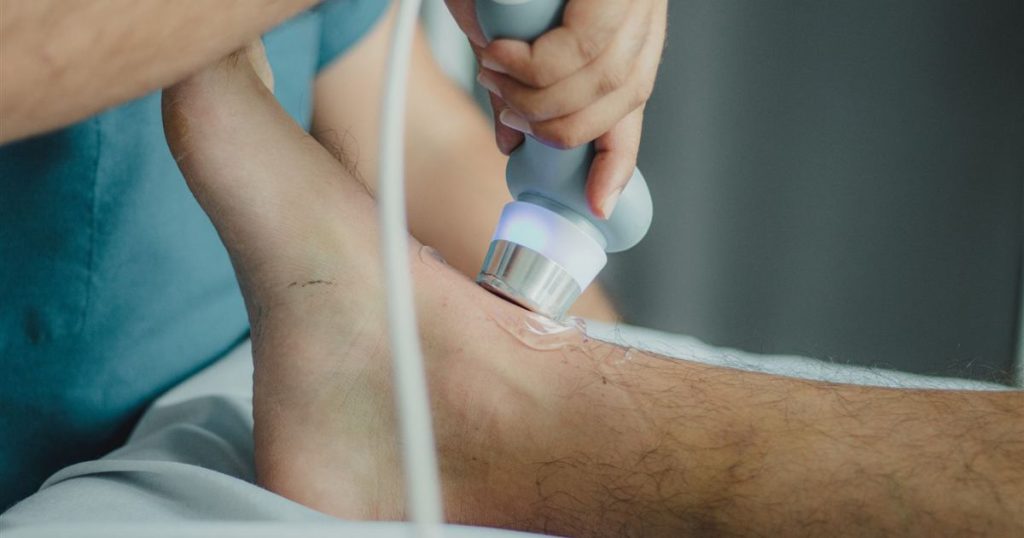
Your provider locates the treatment area by palpation, often finding the exact spot by pressing until you confirm it. Gel is applied to transmit the waves through the skin.
The applicator is pressed against the area and pulses for several minutes. You feel rapid, deep tapping that intensity is adjusted around. Treatment time is typically 5 to 15 minutes depending on the area.
No anesthetic is used, and that is deliberate. Your feedback guides intensity, so being able to feel it matters.
You walk out immediately and return to normal activity, avoiding high-impact loading for about 48 hours. Sessions usually run weekly across a course of 3 to 6.
What It Treats
Shockwave targets tendon and fascia problems that have become chronic.
- Plantar fasciitis and heel pain, the most studied application
- Achilles tendinopathy, both mid-portion and at the heel attachment
- Tennis and golfer’s elbow, tendon problems at the elbow
- Calcific tendinitis of the shoulder, where calcium deposits form in the rotator cuff
- Patellar tendinopathy, sometimes called jumper’s knee
- Hip bursitis and gluteal tendinopathy
- Shin splints and post-surgical scar tissue
The common thread is chronicity. These are problems that have been present for months and stopped improving.
New injuries usually do not need shockwave. Acute tissue is already mounting a healing response, and the standard approach usually works.
Does Shock Wave Therapy Work?
The evidence is stronger for some conditions than others, and honest answers vary by target.
Plantar fasciitis has the largest body of research and the most consistent support. Calcific tendinitis of the shoulder is well supported, with evidence that shockwave can reduce or clear calcium deposits.
Achilles and patellar tendinopathy have reasonable support. Other applications have smaller evidence bases.
The
National Institutes of Health hosts published research on shockwave across these conditions through PubMed, and it is a better starting point than clinic marketing pages for anyone who wants to read the primary studies.
Two honest caveats. Response is not universal, and no provider can tell you in advance which group you fall into. Results build over weeks rather than appearing immediately, so judging after one session tells you nothing.
Shockwave works better alongside progressive loading exercise than alone. Restarting the biology without rebuilding the tissue’s capacity tends to produce relapse.
Can It Cause Damage?
Serious complications are rare in the published literature when treatment is delivered by a trained provider at appropriate energy levels.
Expected effects include soreness in the treated area for a day or two, temporary redness, mild swelling, and occasionally small surface bruising. These settle without intervention.
Treatment is unsuitable in several situations.
- Pregnancy
- Over an active infection or a known tumor
- Blood clotting disorders, or when taking anticoagulant medication
- Over an open growth plate in children and adolescents
- Directly over major nerves or blood vessels
Disclose your full medical history and every medication at the examination. Anticoagulants are the most commonly missed item and the most relevant.
FAQs About Shock Wave Therapy
Does shock wave therapy hurt? It is uncomfortable rather than painful for most people, described as rapid deep tapping. Intensity is adjusted to your tolerance throughout, and discomfort stops when the applicator lifts. Mild soreness for a day or two afterward is normal. Sharp or worsening pain during treatment is not, and should be reported immediately.
How many sessions will I need? Most courses run 3 to 6 sessions about a week apart. The number depends on the condition, how long you have had it, and how you respond. A provider should reassess partway through rather than selling a fixed package before examining you.
How soon will I notice a difference? Many people notice change after the second or third session, with improvement continuing for weeks after the final one. The mechanism is a healing response, which takes time. Judging the outcome the day after your first session is too early to mean anything.
Is shock wave therapy covered by insurance? Coverage varies considerably by plan and is often limited for musculoskeletal shockwave. Call your clinic with your plan details before booking so benefits can be checked. Caron works with BCBS, Cigna, Aetna, Humana, Health Partners, United Health Care, Ucare, Medica, UMR, Primewest, Medicare, and Medicare Advantage plans.
Is it the same as ultrasound therapy? No. Ultrasound uses continuous sound waves primarily for heating and gentle tissue stimulation. Shockwave delivers discrete high-energy pressure pulses that create mechanical stress. The energy levels and the intended biological effect are different.
Find Out If Shockwave Suits Your Injury
An examination establishes whether your problem is chronic enough to benefit and whether anything rules the treatment out. Both answers save you time.
Caron Chiropractic provides
shockwave therapy in St. Paul, rated 4.9 stars across 385 Google reviews.
Book My Shockwave Assessment or call (651) 255-9999.
Reviewed by Matthew R. Caron, D.C., Northwestern College of Chiropractic, 1992.
This article is general information, not medical advice.